Vitiligo can feel unpredictable. One month a patch looks stable, and the next it seems brighter against your skin tone, especially in Dubai where sun exposure can increase contrast. The good news is that phototherapy treatment for vitiligo remains one of the most studied, dermatologist-led options for encouraging repigmentation, and for many patients it becomes the “core” treatment that other therapies build around.
What vitiligo is (and why it happens)
Vitiligo is a condition where melanocytes (the pigment-producing cells) are reduced or lost in certain areas, leading to white patches. It is not contagious, and it is not caused by poor hygiene.
When patients ask about the causes of vitiligo skin disease, the most accurate answer is: vitiligo is usually multifactorial. Research supports an autoimmune component in many cases, with genetic tendency plus triggers such as friction, skin injury (Koebner phenomenon), stress, or inflammation playing a role. In practice, this is why your dermatologist will ask about family history, thyroid disease, new patches after waxing or shaving irritation, and whether lesions are actively spreading.
What is phototherapy for vitiligo?
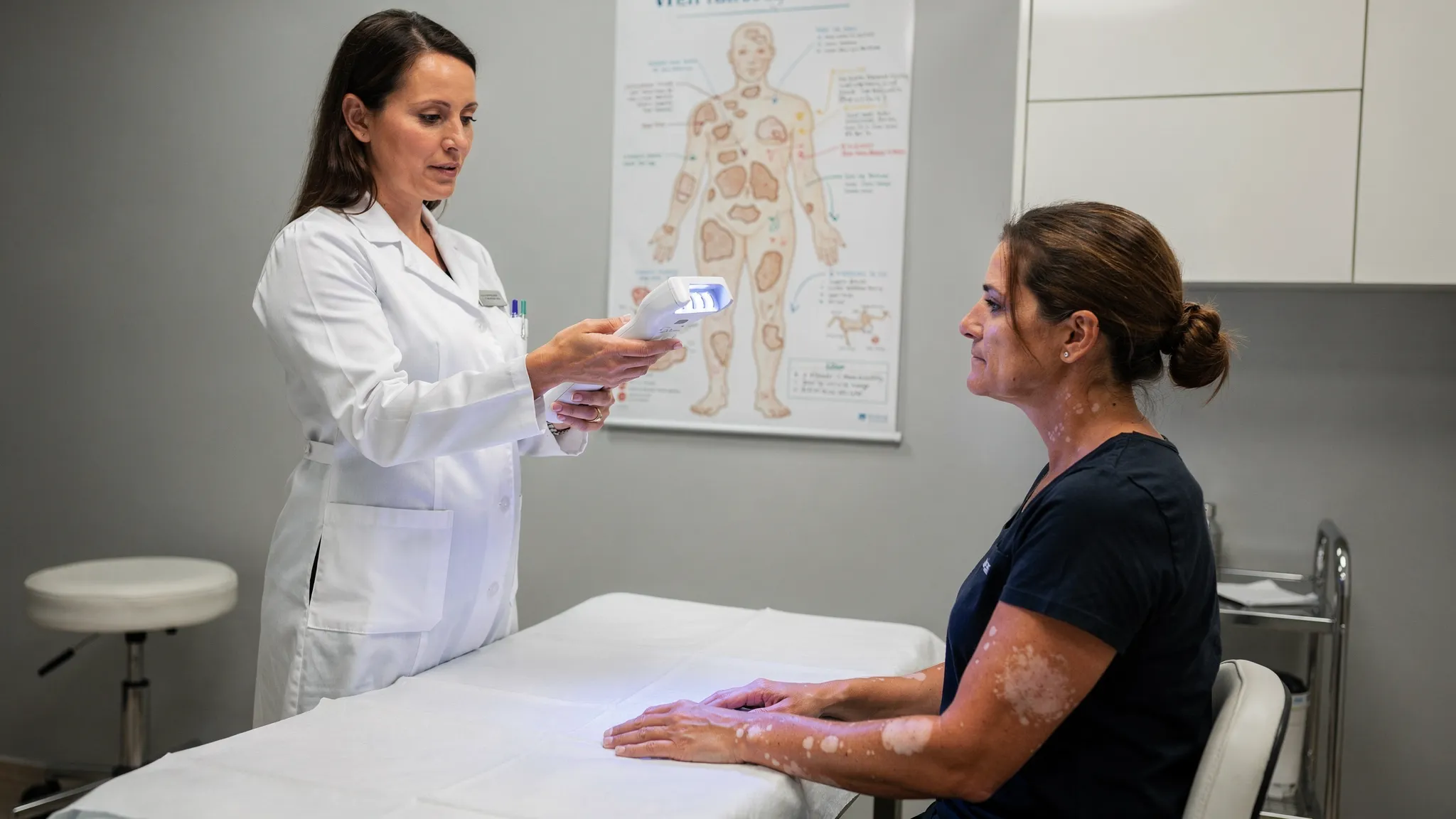
Phototherapy uses controlled medical light (usually ultraviolet B) to stimulate melanocyte activity and calm local immune activity in the skin. The goal is gradual repigmentation and better color blending.
The most common medical option worldwide is narrowband UVB (NB-UVB). It is widely recommended in major dermatology guidelines as a first-line treatment for many cases of generalized vitiligo.
There are also targeted light options for smaller areas.
How effective is phototherapy treatment for vitiligo?
Effectiveness depends on three main factors: where the patches are, how long they’ve been there, and whether the vitiligo is active.
Here’s what many studies and clinical guidelines consistently show:
-
Best responders: face and neck (often repigment faster)
-
Moderate responders: trunk and upper arms
-
Hardest areas: hands, feet, fingertips, and lips (fewer hair follicles and melanocyte “reservoirs”)
What “good results” usually look like in real life
Before-and-after results with phototherapy rarely look like a sudden “full return” of color overnight. In typical clinical photo series, repigmentation often begins as:
-
Perifollicular repigmentation: tiny dots of color around hair follicles that expand and merge
-
Edge repigmentation: color fills from the border of the patch inward
-
Blending over time: patch borders soften, contrast reduces, and makeup becomes optional rather than necessary
A realistic timeline is important. Many people need months, not weeks. With consistent sessions, some patients start noticing early changes around 8–12 weeks, while stronger visible changes commonly require a longer course.
This is why phototherapy treatment for vitiligo is often described as a “commitment-based” therapy: results are possible, but consistency is the multiplier.
Phototherapy vs excimer laser (and where “laser” fits in)
Patients often search for vitiligo laser treatment and assume laser is automatically stronger. In reality, “laser” in vitiligo usually refers to targeted excimer light (commonly 308 nm), which is excellent for specific patterns and smaller areas.
Here’s a simple comparison to help decision-making.
| Option | Best for | Typical advantages | Key limitation |
|---|---|---|---|
| NB-UVB phototherapy | Widespread vitiligo | Treats larger areas, strong evidence base | Requires multiple sessions over time |
| Targeted excimer light (often called laser by patients) | Small patches, focal areas | High intensity to a defined spot, can be efficient for limited lesions | Less practical if patches are widespread |
| Topical medications (doctor-prescribed) | Localized disease, early patches | Convenient, can pair with light therapy | Results vary by site and adherence |
In many real treatment plans, the decision is not “either/or.” Dermatologists often design a strategy where light therapy does the heavy lifting, and topical therapy supports it.
What predicts better (or slower) results?
If you’re trying to estimate outcomes, these factors matter more than the brand of device:
-
Location: face responds better than hands and feet
-
Duration: newer patches often respond faster than long-standing ones
-
Stability: rapidly spreading vitiligo may need medical stabilization first
-
Skin type and lifestyle: in Dubai, sun exposure and tanning can increase contrast, which affects how results look even before true repigmentation completes
Safety and side effects (especially in Dubai’s sun)
When supervised by a qualified dermatologist, phototherapy is generally considered safe. Common short-term side effects can include temporary redness, mild itch, dryness, or a sunburn-like feeling if dosing needs adjustment.
Two Dubai-specific practical points:
-
Sun behavior matters: you do not want accidental overexposure on treatment days. Sun protection and consistent habits reduce irritation and help color blending.
-
Tracking is part of safety: good clinics document settings, skin response, and progress photos so dosage remains controlled.
If you have a history of photosensitivity, are on certain medications, or have other skin conditions, your dermatologist will tailor the plan.
Is phototherapy the best treatment for vitiligo?
Many patients ask for the single best treatment for vitiligo, but vitiligo is not one-size-fits-all. A more useful question is: “What’s the best plan for my pattern, my skin type, and my timeline?”
In modern practice, phototherapy treatment for vitiligo is often a leading option for generalized non-segmental vitiligo because it balances effectiveness, safety, and long-term usability.
This is also where trends are going in 2025 and beyond:
-
Combination protocols: pairing light-based treatment with prescription topicals, when appropriate
-
Better outcome tracking: standardized photos, body maps, and physician scoring to judge progress objectively
-
Targeted technology: more personalized approaches depending on patch location and activity
If you are exploring vitiligo treatment in dubai, consider choosing a clinic that focuses on documentation and strategy (not just “sessions”), because vitiligo outcomes improve when your plan is adjusted based on measurable change.
A simple “before and after” checklist you can use
To make before-and-after results meaningful, you need consistency. Here’s what dermatologists typically recommend patients do:
-
Take photos in the same lighting and angle every 4 weeks
-
Include a reference point (a mole, freckle, or a small ruler) for scale
-
Track triggers: friction, waxing irritation, sun exposure, stress spikes
-
Note when you see dot-like pigment return (often an early positive sign)
This makes it easier for your doctor to decide whether to continue, intensify, switch to targeted light, or add supportive therapies.
Where do HIFU, microneedling, fillers, Botox, and chemical peels fit?
These treatments are popular in Dubai, but it’s important to place them correctly.
-
HIFU (High-Intensity Focused Ultrasound): used for skin tightening and collagen stimulation. It does not treat vitiligo pigment loss directly, but it may be part of an overall confidence and facial rejuvenation plan.
-
Microneedling: supports texture and collagen remodeling. It is not a primary vitiligo repigmentation treatment, and it must be used carefully because skin injury can trigger new patches in some patients.
-
Dermal Fillers (Liquid Facelift): restore volume and smooth wrinkles. Helpful for aesthetics, not pigment replacement.
-
Botox: reduces expression lines and can refresh the face while vitiligo treatment is ongoing.
-
Chemical Peels: can brighten uneven tone from sun damage or post-acne marks, but they are not a direct vitiligo solution and must be selected cautiously for sensitive skin.
A high-quality plan uses these options strategically, without irritating the skin or confusing pigment improvement with general “glow” treatments.
Frequently Asked Questions
How long does phototherapy take to work for vitiligo? Many patients need a few months to see early changes, and a longer course for more visible repigmentation. Your dermatologist will evaluate progress with consistent photos and clinical exams.
Is phototherapy for vitiligo safe for long-term use? Under dermatologist supervision and with controlled dosing, it is widely used. Your treatment plan should include regular reviews to balance results and skin safety.
Is excimer “laser” better than phototherapy? It depends on the pattern. Targeted excimer light can be great for small areas, while NB-UVB is often more practical for widespread patches.
Can I combine vitiligo care with cosmetic treatments like Botox or fillers? Often yes, but timing and skin sensitivity matter. A dermatologist should plan it so your skin barrier stays stable and you avoid unnecessary irritation.
Plan your vitiligo strategy with a dermatologist-led approach
If you want a clear, practical plan (with realistic timelines, photo tracking, and treatment comparisons), book a consultation at Modern Aestheticss Dermatology and Laser Clinic. Under the care of Dr. Shubhangi Perkar, recognized by many patients as a Best Dermatologist in Dubai, you can discuss whether phototherapy treatment for vitiligo is the right foundation for your case, and how to build a smart combination plan around it.