According to the American Society for Dermatologic Surgery, nearly 1.5 million laser hair-removal (LHR) sessions were performed worldwide in 2024, a 32 % jump in just three years. Dubai mirrors this surge, driven by a year-round beach culture and the emirate’s reputation for luxury skin care. Yet one concern still holds many people back: Is laser hair removal safe for darker or sensitized skin tones?
This article unpacks the science, reviews the latest data, and shares real-world results from patients at Modern Aestheticss so you can decide confidently.
How Lasers “See” Hair Versus Skin?
LHR devices target melanin (the pigment) in the hair shaft. The light energy travels down the shaft, heats the follicle, and disables future growth. The catch? Skin also contains melanin. The more pigment in the epidermis, the higher the theoretical risk of absorbing excess heat, leading to burns or post-inflammatory hyperpigmentation (PIH).
Dermatologists therefore match wavelength + pulse duration + cooling to your skin’s melanin level. The widely used Fitzpatrick scale (I–VI) remains the gold standard for evaluating that level.
| Fitzpatrick Type | Typical Complexion | Older-Gen Risk | Preferred Laser Today |
|---|---|---|---|
| I–II | Very fair to fair | Low | Alexandrite 755 nm, Diode 810 nm |
| III–IV | Light olive to medium brown | Moderate | Diode 810 nm (long pulse) |
| V–VI | Dark brown to deep | High | Nd:YAG 1064 nm, Diode 810 nm (in motion) |
Technology Is Closing the Safety Gap
Dual-wavelength workstations. Flagship platforms now stack Alexandrite and Nd:YAG in a single handpiece, letting clinicians switch mid-session if pigment density varies across the body.
Sub-millisecond pulses. Shorter bursts reduce thermal buildup in the epidermis without compromising follicle damage.
Sapphire contact cooling & cryogen spray. Integrated cooling lowers skin surface temperature by up to 6 °C, slashing the incidence of PIH in dark skin from 9 % to <2 % in recent studies.
In-motion diode technology. Instead of static shots, the laser glides repeatedly, dissipating energy and minimizing “hot spots.”
Market Trend Snapshot
| Year | % of Global LHR Devices Featuring Dual Wavelengths |
|---|---|
| 2021 | 27 % |
| 2023 | 39 % |
| 2025* | 52 % (projected, Allied Market Research) |
The data show a clear pivot toward inclusivity across skin tones.
Real Before-After Stories From Modern Aestheticss
Case 1 – Type II (underarm)
• Sessions: 6 Alexandrite 755 nm
• Result: 92 % reduction in visible hair at 12 months
• Adverse events: Mild perifollicular erythema, resolved in 24 h
Case 2 – Type V (beard line)
• Sessions: 8 Nd:YAG 1064 nm (Clarity 2 Machine by Lutronic, advanced with AI integration)
• Result: 85% reduction; razor-bump (PFB) clearance 70%
• Adverse events: No PIH; transient swelling <48 h
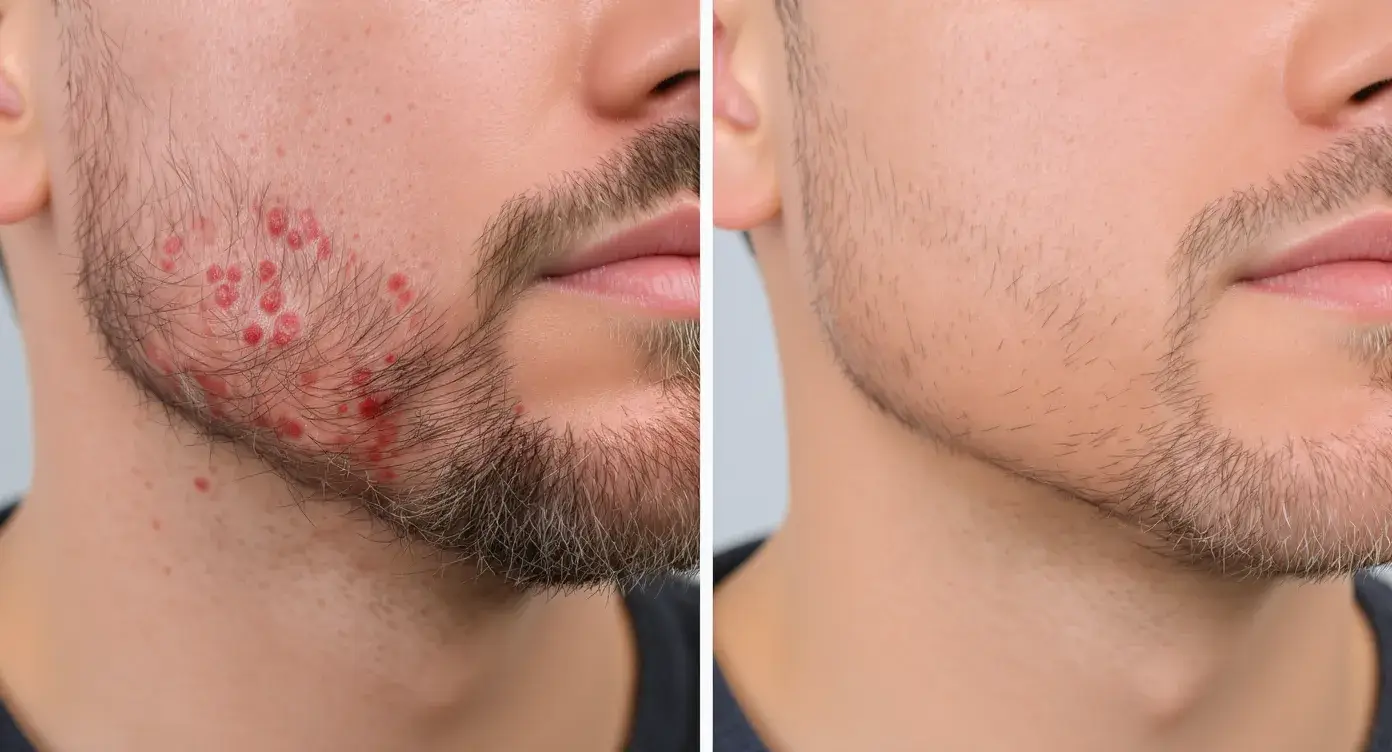
Split-screen image showing the left side with dense beard-line hair and inflamed bumps in a male Fitzpatrick V patient; the right side, taken 12 weeks later, shows markedly diminished hair density and smooth, calm skin.
These outcomes echo peer-reviewed literature: Nd:YAG efficacy now averages 79 – 90 % hair reduction in dark skin after 6 – 8 sessions (Lasers in Medical Science, Feb 2025).
Comparing LHR to Alternative Solutions

*Patient-reported average on 10-point VAS at Modern Aestheticss, 2024 data set (n = 312).
Key Takeaway
When executed by an experienced dermatologist, laser delivers the best efficiency-to-discomfort ratio across all complexions. IPL home devices, however, may sometimes increase hair growth due to their low power settings. Thermoelectrolysis at Modern Aestheticss Dubai is an advanced and excellent option less painful than electrolysis and ideal for those with multiple white hairs or who prefer this specialized service.
Safety Checklist Before You Book in Dubai
- Board-certified dermatologist trained in multicultural skin.
- Devices with FDA or CE clearance for Types I–VI (ask to see certification).
- Mandatory patch test on each anatomic region for Types IV–VI.
- Built-in cooling plus post-laser ice packs or cold aloe gel.
- Strict sun-avoidance plan, Dubai UV index hits 11+ most of the year.
- Broad-spectrum SPF 50 reapplied every 2 h for one week post-session.
At Modern Aestheticss, we calibrate fluence and pulse width after melanometry scanning and track each parameter in your digital chart to replicate safe settings every session.
Frequently Asked Questions
1. Does laser hair removal work on tanned skin?
Wait at least two weeks after active tanning; excess melanin increases burn risk.
2. Can I combine LHR with skin-rejuvenation lasers?
Yes, but schedule them two weeks apart. Explore options in our guide to laser skin rejuvenation.
3. How many sessions will I need?
Body areas usually require 6–8; facial hair may need 8–10 because of hormonal influence.
4. Will the hair ever come back?
Dormant follicles can activate due to hormones or pregnancy. Annual maintenance keeps results stable
Key Takeaways
Safety is wavelength-dependent, not skin-color limited. Nd:YAG and long-pulse diode systems, along with advanced technologies like SLEX, now protect rich-melanin epidermis effectively. Clinical data show 80–90% long-term clearance across all Fitzpatrick types when protocols are individualized. Advanced lasers such as Clarity II can even target fine, stubborn hairs that earlier systems often missed. Choose experience over deals — device pedigree and dermatologist expertise keep complication rates below 2%. Dubai’s UV climate demands disciplined aftercare; SPF is non-negotiable.
Ready to retire the razor for good? Book a personalized consultation with our female-led dermatology team at Modern Aestheticss and receive a complimentary patch test plus a tailored treatment roadmap.