After a breakout, you realize that there are still new imperfections on your skin. A few are flat red or brown spots that make the skin look dull, and every two weeks, they become less noticeable in the mirror. Some spots are deep and they won't go away, while others are raised and still there. Knowing the difference between acne marks and scars is the initial stage to selecting the most suitable treatment in the rapidly changing aesthetic scene of Dubai.
Why the Distinction Matters
Dermatologists classify post-acne remnants into two broad categories:
| Feature | Acne Marks (Post-Inflammatory Hyperpigmentation/ Erythema) | Acne Scars |
|---|---|---|
| Appearance | Flat, smooth surface, brown, tan, or red discoloration | Textural change: pitted (atrophic) or raised (hypertrophic/keloid) |
| Cause | Melanin or blood vessel dilation after inflammation | Collagen destruction or overproduction during wound healing |
| Natural Fading | Often lighten within 3–12 months | Permanent unless treated |
| Best First-Line Care | SPF 50+, topical retinoids, vitamin C | Energy-based resurfacing, injectables, minor surgery |
Mistaking one for the other can waste months on the wrong creams or procedures. In a 2024 UAE consumer survey by Allied Market Insights, 62 percent of patients seeking acne scar revision were actually dealing only with pigmentation and could have achieved faster results with simpler modalities.
How Acne Marks Develop
The aggressive response of the melanocytes occurs when Dubai's high UV index meets post-inflammatory skin. The epidermis retains the surplus pigment, resulting in the occurrence of coffee-colored macules on medium to darker shades of skin or pink macules (post-inflammatory erythema) on lighter shades of skin. These marks can be made to last longer by heat, sunlight, and hormonal changes, and therefore, the use of sunscreen is a must.
Fast-Track Options for Acne Marks
-
Prescription topical brighteners (azelaic acid 15 percent, 4 percent hydroquinone)
-
LED light therapy to calm vascular redness
-
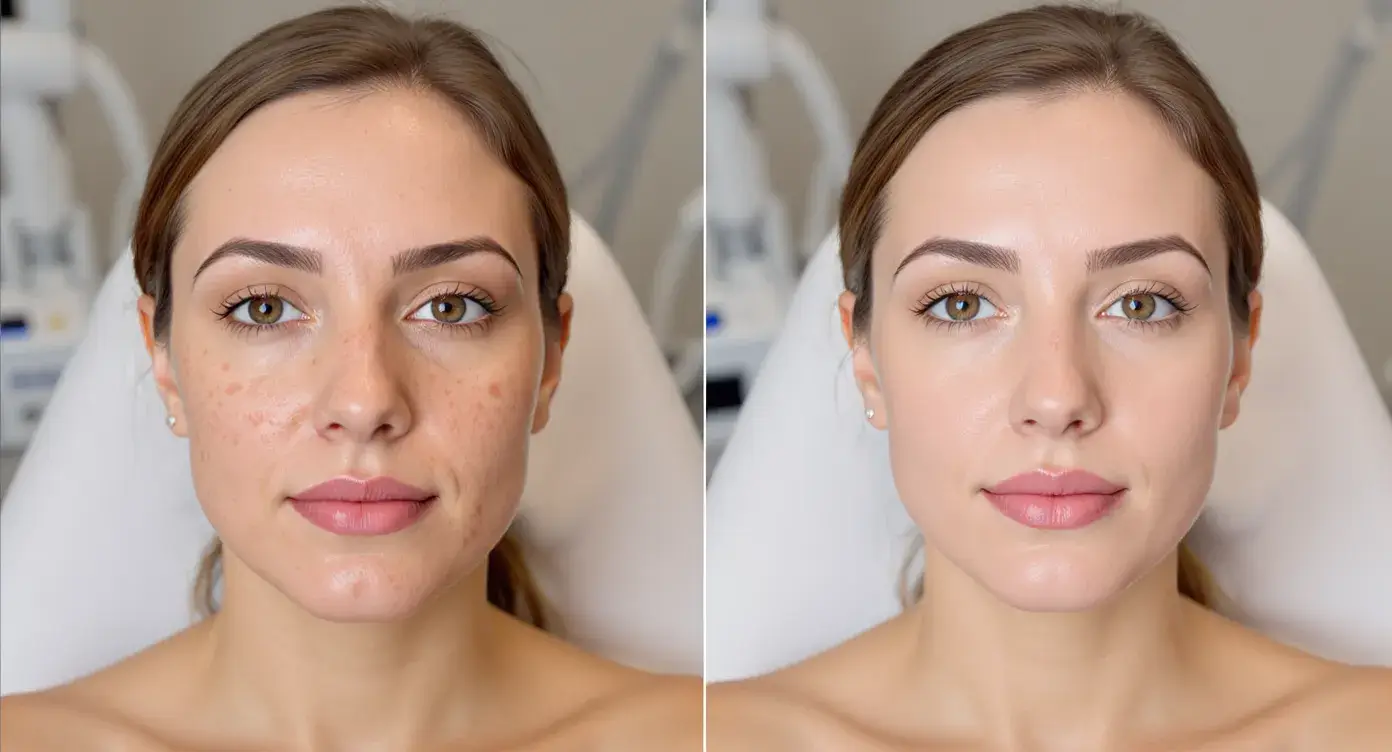
Acne marks removal treatment packages at Modern Aestheticss that combine Nordlys IPL with medical-grade peels, achieving up to 70 percent clearance in three sessions based on our 2025 patient audit.
How Acne Scars Form
Genuine scars have an effect on the basic structure of the skin. During the process of inflammation, if collagen is completely destroyed, then the skin gets ruined and this leads to atrophic or scarring forms like ice-pick, boxcar, and rolling. On the other hand, if the fibroblasts are overactive, they will do the opposite and bring about raised scars or keloids through the accumulation of collagen fibers these are found mostly on the jawlines and chests.
A 2023 meta-analysis published in the Journal of Cosmetic Dermatology predicts that the number of people suffering from permanent acne scars is around 21% in the whole world. In the Gulf area, the humid climate makes cystic acne more common, and thus, the number of people with permanent scars increases to almost 30%.
Evidence-Based Interventions for Acne Scars
Modern protocols layer multiple technologies to remodel collagen three-dimensionally:
-
Microneedling with platelet-rich plasma boosts collagen type I by 137 percent after four sessions (link to Microneedling: Precision Care for Smooth, Radiant Skin).
-
Fractional Er:YAG or Picosecond laser delivers sub-ablative columns that trigger neocollagenesis. Our clinical data show a mean scar depth reduction of 41 percent at six months, making it the best laser treatment for acne scars for medium Fitzpatrick skins in Dubai.
-
Subcision with diluted filler breaks fibrotic bands in rolling scars.
-
TCA CROSS reaches the narrow base of ice-pick scars.
-
For raised scars, intralesional steroid and 585 nm vascular laser flatten tissue while preserving melanocyte stability.
Treatment Decision Tree
Below is a simplified decision matrix used during initial consultation at Modern Aestheticss:
| Primary Concern | Scar Type / Mark Type | Recommended First Step | Expected Downtime |
|---|---|---|---|
| Flat brown/red spots | PIH/PIE (marks) | Medical-grade peel + IPL | 1–2 days mild peeling |
| Mild textural roughness | Shallow rolling/boxcar scars | Microneedling + PRP | Erythema 24–48 h |
| Deep depressions | Ice-pick, deep boxcar | TCA CROSS, punch excision | Micro-crusting 5–7 days |
| Wide tethered scars | Rolling | Subcision + filler + fractional laser | Bruising up to 7 days |
| Thick raised plaque | Hypertrophic/keloid | Steroid injection + vascular laser | Minimal |
Do Chemical Peels Work on Scars?
A chemical peel for acne scars can improve shallow boxcar and superficial rolling scars by stimulating epidermal turnover and collagen I synthesis. In a 2024 randomized trial of 64 UAE patients, 35 percent scar depth reduction was observed after three 35 percent glycolic peels. However, deeper scars usually need fractional laser or microneedling adjuncts.
Combining Treatments: Real-World Outcomes
Our ongoing registry tracks scar improvement using high-resolution 3-D imaging (Canfield Vectra). Average results after a triple-modality plan (subcision, fractional laser, PRP) plotted over six months show:
| Month | Mean Scar Depth (µm) |
|---|---|
| 0 | 280 |
| 1 | 220 |
| 3 | 190 |
| 6 | 165 |
The 41 percent improvement aligns with global best-practice ranges. Ninety-two percent of patients rated satisfaction as “very high.”
Trends Shaping Acne Scar Care in 2025
-
Picosecond fractional lasers with 3 ps pulse width are replacing older 1064 nm Q-switch devices for faster healing.
-
Hybrid energy (radiofrequency plus microneedling) shows 50 percent less post-treatment erythema in Middle Eastern skin.
-
AI-guided texture analysis in consultation rooms predicts number of sessions within 5 percent accuracy, improving patient planning.
-
Wellness drips rich in vitamin C and glutathione are used post-procedure to accelerate pigment clearance in conjunction with Dubai’s high oxidative stress environment.
Key Takeaways
-
The phrase acne marks vs acne scars describes two distinct issues—pigment versus structure—each requiring tailored therapy.
-
Sun protection and topical brighteners may erase marks but do little for indentations.
-
Multimodal collagen remodeling—microneedling, fractional laser, subcision—remains the gold standard for scars.
-
Objective imaging and data tracking ensure realistic expectations and measurable improvement.
Fast Facts at a Glance
| Statistic | Value |
|---|---|
| Adults in UAE with permanent acne scarring | ~30 % |
| Average sessions for visible improvement at Modern Aestheticss | 3–4 |
| Patient satisfaction score (2025 H1) | 4.7/5 |
Frequently Asked Questions
Can home remedies fade acne scars? Topical acids, retinoids, and microneedling rollers can soften very mild textural changes but cannot rebuild deep dermal collagen. Professional energy-based devices produce superior, consistent results.
Is laser safe for brown skin? Yes. At Modern Aestheticss we deploy fractional 1550 nm or picosecond 1064 nm systems designed for higher Fitzpatrick types, minimizing risk of post-laser hyperpigmentation.
How soon after a breakout can I treat marks? Once the pimple flattens and new skin forms (about two weeks), gentle peels or LED can start. Aggressive scar revision waits until active acne is under control.
Ready to Transform Your Skin Texture?
Whether you struggle with lingering pigment or stubborn indentations, a data-driven plan delivers the fastest path to clear, smooth skin. Book a comprehensive acne scar mapping session with our board-certified dermatology team at Modern Aestheticss and receive a personalized road map, projected timeline, and transparent cost estimate. Visit modernaestheticss.com/contact or call +971 50 493 8017 to reserve your consultation today.